 I thought he was sent to spy on the Earl of Essex, because I’d never before seen a cat rowed across the river by a waterman.
Scabface seized him by the throat and held him down. I commenced the interrogation.
What was he? Whom did he serve? What business had he on our side of the river?
Between his yowls and pleas for mercie, he swore he was an honest cat. In the service of the Lord Chamberlain. Visiting friends in Black-Fryes.
So why had he come to Essex House and leapt onto our river wall?
He confessed he didn’t know where Black-Fryes was.
Now that were wondrous strange. The Lord Chamberlain had a house in Black-Fryes.
Yet all this cat could tell me of Black-Fryes was that he’d heard of a playhouse there that gave plays for the better sort.
I arrkst him why he’d concealed hisself in the boat that carried Essex’s friends.
He gasped, “To cross the water.”
Scabface gave him kicks for that impudencie.
So then he sayt that once across the river he’d hoped to find his way to Paws [St Paul’s]. And enkwire there for Black-Fryes, and his friends.
I demanded to know who these friends were.
Two sisters, sayt he. Who’d come to him last spring. Seeking Snakes-Purr the player.
I bade Scabface release him then.
He spake more free without Scabface’s teeth at his throat.
He sayt he’d told those sisters where Snakes-Purr might be found, but they – being citie queens – had no wish to cross the river.
Nor had he, then. The south bank was a wicked place, festered with bears and bulls and bloodie dogs. But one day he – being curious – followed a player from the playhouse in the fields along the street that led to the bridge.
When he wished to turn back, a gang of ruffians [dogs] chased him. He ran through the citie’s gate, and sought shelter at an inn.
And having come so far, he journeyed on. Inn to inn. Then he crossed the bridge, praying no wicked person would cast him in the river for sport.
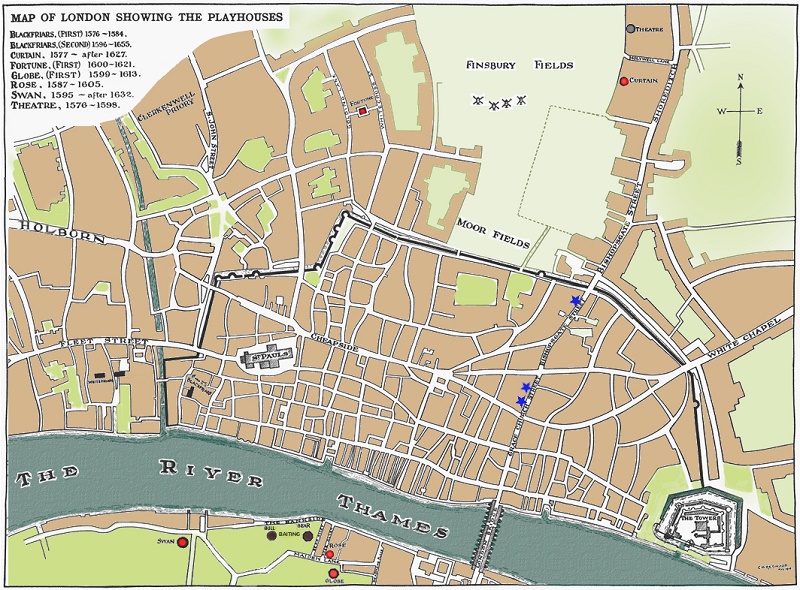
He set out from the vicinity of the Curtain (upper right) and made his way south to the bridge.
The blue stars mark the inns where he may have sheltered – these had yards where plays were performed.
The brown circles on the south bank mark the approximate sites of bear and bull baiting; the playhouses are red. Note: This map shows only the playhouses existing before the end of the 16th century.
He crept through the fearsome southern stinks until he nosed his Theater, built anew and named the Glob. His old company, the Lord Chamberlain’s men, was there. Snakes-Purr among them.

It was at the Glob he saw the gentlemen. They’d come to bespeak a play of their own choosing.
“What play was that?” I arrkst, thinking of my uncle’s play in which I acted the Maggot.
“An old thing,” sayt he. “About a fool king. There’s no kew [cue] for a cat in it. So when the gentlemen went to the river to call for oars I followed them. The wind was chill, and all sat hunched. None saw me creep aboard.”
Scabface, wearie of this talk, gave me winks and slipped away. I guessed he meant to go to White-Hall and make readie for the actions to come.
I told the Player Cat I was bound for Black-Fryes. He, having nowhere else to go, came limping after me.
How ill we’d used him on first akwayntance! Rightly so, as it fell out, but I did not know that then.
 Tricks is as indifferent to days and dates as her uncle Gib was, but the Player Cat’s interrogation must have taken place on Thursday 5 or Friday 6 February 1601.
On one of those days Essex supporter Sir Charles Percy, with a few others, commissioned a performance of a play “variously described as being ‘of Harry the iiiith,’ ‘of Kyng Harry the iiiith and of the kyllyng of Kyng Richard the Second,’ and ‘of the deposyng and kyllyng of Kyng Richard the Second’.”[1]
 This was to be played at the Globe on Saturday.
Was it Shakespeare’s Richard II? Or a play by someone else?
It’s a matter of scholarly debate, but historian Paul Hammer favours Shakespeare’s Richard II.
Well, we do know the play wasn’t written by Gib because it’s of no interest to Tricks.
[1] Paul E. J. Hammer: Shakespeare’s Richard II, the Play of 7 February 1601, and the Essex Rising in Shakespeare Quarterly, Vol 59, No.1, Spring 2008 pp. 1-35
 The Earl of Southampton's Cat