
Nero arrkst me why I’ve told no tales of late.
I sayt, “I’m composing sonnets. I have no time for trifles.”
Nero cleansed his paws, nibbling betwixt his claws most careful. I guessed he did not know what a sonnet were.
I told him of my sonnet in honour of my friend Smokie. And of another I have in mind. A platonick conceit on my soul.
Nero eyed me scornful.
“The great Sit-Knee, the flower of our age,” sayt I, “is famed for his sonnets.”
“Be he a man or a cat?”
“A man. All praise him most high, and strive to emulate him.”
“Then Sit-knee must be gone from this world, and past giving offence to any,” sayt Nero.
“True,” I sayt. “He died heroick. The Earl of Essicks [Essex] has his sword. And his wife, to the great annoyance of Her Majestie.”
We sat a while in silence.
Then Nero sayt, “Your sister says we see little of you because it makes you mopish to think of other poets running after our Earl. She says it was ever in your nature to be dumpish.”
My sister should learn to hold her tongue. You would think she had kits enough to keep her busy. But no, she must ever be blabbing about me.
I sayt, “Friend, we poets are never mopish or dumpish. That’s for lesser wits. We are melancolie.”
“Melancolie?” arrkst he, liking the word.
“We long for what we cannot have. Our loves are unrequited.”
“I long for plump oysters when there’s none to be had,” sayt Nero.
“Then,” sayt I, “think on your oysters and follow me to yonder eglantine.”

Nero sayt, “I call that a rose.”
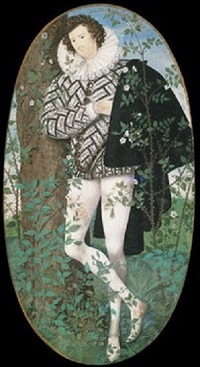
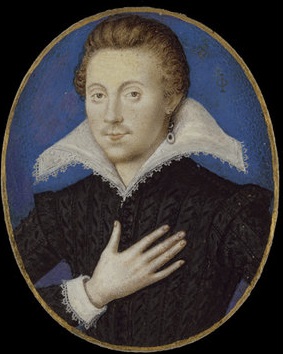
I sayt, “Eglantine signifies Her Majestie. All feign to love her. Now we must lay our paws upon our hearts to signify that we are love-struck. And, being of a poetick disposition, that makes us melancolie.”
I rose on my legs to show him what I meant.
But we cats are not so made that we can put our paws upon our hearts without we lie on our backs.
And when we lie on our backs, our friends think we are inviting them to fight us in play.
Nero leapt on me. I kicked him off, and told him it was his turn to seem melancolie.
He did it well.
“You show,” sayt I, “the blackest face of woe I ever saw.” And I leapt on him.

Then what did we see but the Mad Cat peeking at us over a little wall. He was standing on his legs, which he is most apt to do. He holds his paws at his sides for balance.
I arrkst him if he could place a paw upon his heart without falling down.
“And think,” sayt Nero, “of your mistress eating an egg, and not offering you a morsel.”
I sayt, “There is nowt more poetickal than a cruel mistress.”
“My good mistress never would be cruel,” sayt he. “She will call me to my supper soon.”
But our melancolie looks had joyed him, and he came to sit with us beneath the roses.

 Sir Philip Sidney – Gib’s Sit-Knee – (1564-1586) was regarded by his contemporaries as the perfect Renaissance courtier: a soldier, scholar, author, and patron of the arts.
As a writer, he’s best remembered now for his influential sonnet sequence Astrophel and Stella, and for his essay The Defence of Poesie on the value of imaginative writing.
He died of gangrene as the result of a leg wound received at the battle of Zutphen (in the Netherlands) where he was fighting for the Dutch Protestant cause against the Spanish. His wife was Frances Walsingham, the daughter of Sir Francis. In 1590 she married Queen Elizabeth’s young favourite Robert Devereux, Earl of Essex (1565-1601), who’d also distinguished himself at Zutphen. I think both the Earl of Essex and the Earl of Southampton regarded Sir Philip Sidney as what we would call their role model.
 The Earl of Southampton's Cat